Johnian magazine issue 55, spring 2026
One to watch: Can algorithms grow better crops?
Dominic Hall (2013) is applying artificial intelligence to one of agriculture’s most pressing challenges: how to improve a crop’s yield and ability to thrive in the face of climate change.
After studying Maths at St John’s, Dominic co-founded Biographica, a start-up whose aim is to help seed companies identify which genes to edit in order to produce traits ranging from drought tolerance to disease resistance and improved nutritional content.
His company is, he says, building “a discovery engine for gene editing in agriculture”. The aim is to help seed companies identify which genes to edit in order to produce traits ranging from drought tolerance to disease resistance and improved nutritional content.
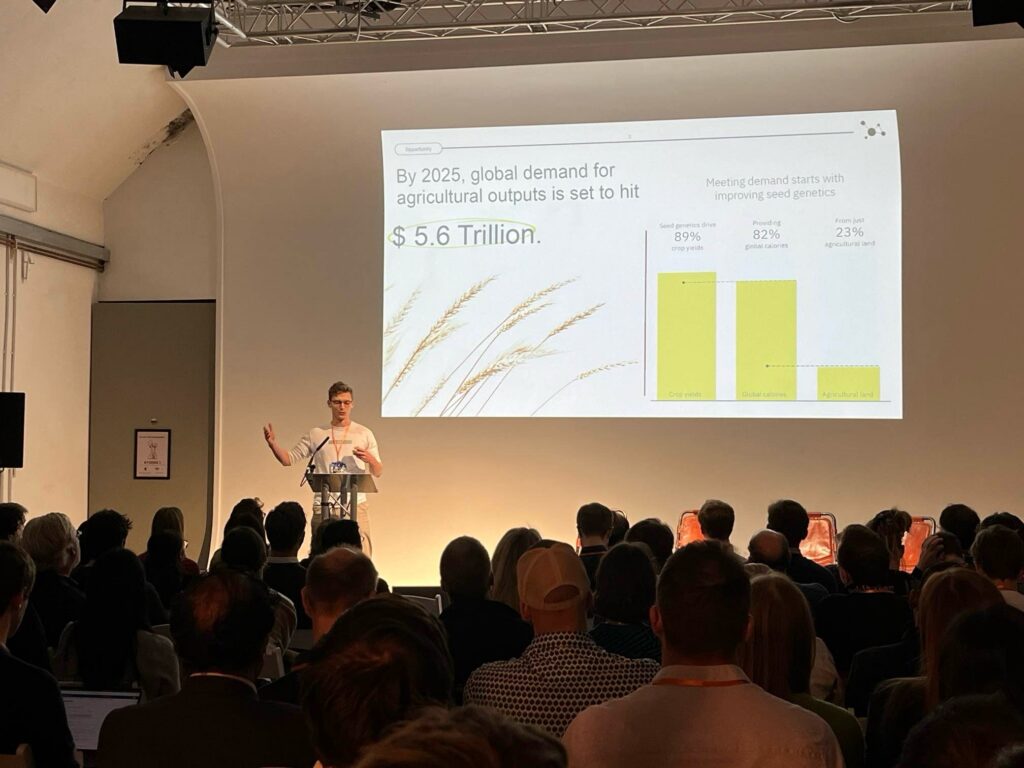
“Breeding has typically had very long timelines associated with it,” he says. “Gene editing is a very promising technology for speeding that up. But in order to create a beneficial trait, you need to know what to edit. And that’s a very hard, unsolved problem.”
A single plant genome may contain 30,000 to 50,000 protein-coding genes and their effects are rarely isolated, meaning there may be unexpected side effects to any changes made. “Individual genes might influence tens or even hundreds of other genes,” Dominic explains. “You might have a gene that’s extremely positive for drought tolerance but has severe yield penalties. So you have these trade-offs everywhere.”
Traditional methods such as genome-wide association studies can identify regions of DNA correlated with a trait. But he points out that correlation is not causation. “You might find a hotspot that seems to correlate with yield,” he says. “Then you have this prediction problem: what nearby genes should I edit? And is it causal or just correlated?”

Biographica’s approach is to use machine learning models to bridge that gap. Rather than relying on literature, Dominic says the company builds models capable of “de novo reasoning”, designed to predict novel targets rather than simply reproduce published findings. Instead of simply linking differences in DNA to visible traits, the models try to map the chain of biological events in between, such as how a genetic change alters gene activity, how that affects cells, and how those cellular changes eventually shape the plant’s characteristics.
To test their performance, the team conducted a large benchmarking exercise, curating a decade of published gene-editing results for traits such as flowering time in soybean crops. “Would the models re-predict the results that were previously observed in the literature?” Dominic asks. “Surprisingly, we found that a single model we developed dominated the others.” The new model achieved hit rates of 40-60 per cent – orders of magnitude higher than classical discovery methods (such as GWAS) on the same benchmark.
While yield remains of peak importance for seed companies, Dominic expects that many will increasingly seek crops that can thrive under abiotic stress, such as drought, heat, salinity and cold, due to the effects of climate change. He also anticipates strong interest in changes that enhance nutritional quality. He points to gene-edited tomatoes enriched in GABA as an example of how crop science can intersect with public health. “Increasing the nutritional content of food is an aspect of food security I wasn’t fully aware of when we started,” he says.
Dominic read Mathematics at St John’s before completing a PhD on genetic regulation in mammalian stem cells at the Cambridge Stem Cell Institute. “Even though we’re in biology, a mathematical background has been deeply useful,” he reflects. After a period in drug discovery, he co-founded Biographica through the Entrepreneur First accelerator programme that helps match co-founders.
Whether algorithms will materially reshape crop development remains an open question. But in a sector where development cycles are long and environmental pressures increasing, even small gains in prediction can make a difference. Three and a half years on, Dominic sees significant room for growth. “It’s an extremely scalable approach to discovery,” he says. “The question now is how we package it to deliver maximal value to the maximum number of customers.”