Johnian magazine issue 55, spring 2026
Since St John’s: Bhaswar ‘Joy’ Chatterjee
The race to fund AI and the energy to run it are the main focus of Bhaswar ‘Joy’ Chatterjee’s (1992) role as Managing Director, Global Head, Real Assets and Trade Finance Distribution at Natixis Corporate and Investment Bank. As investment in AI and energy surges to unprecedented levels, his story offers a unique perspective on the global forces shaping the next era of infrastructure.
Bhaswar ‘Joy’ Chatterjee (1992) has always been at the forefront of new types of infrastructure projects. A career in finance has seen him working on the early public-private partnerships in the roads sector, on rail privatisation in the UK, and on some of the earliest green energy projects in Europe.
At St John’s Joy studied maths and physics as part of the Natural Sciences Tripos before switching in his final year to electrical and information sciences in the Engineering Department. Having come from India, at Cambridge he was exposed to an exciting blend of traditions and innovation. “Learning about neural networks in my studies while also attending plays at the ancient School of Pythagoras provided”, he says, “a unique experience”.
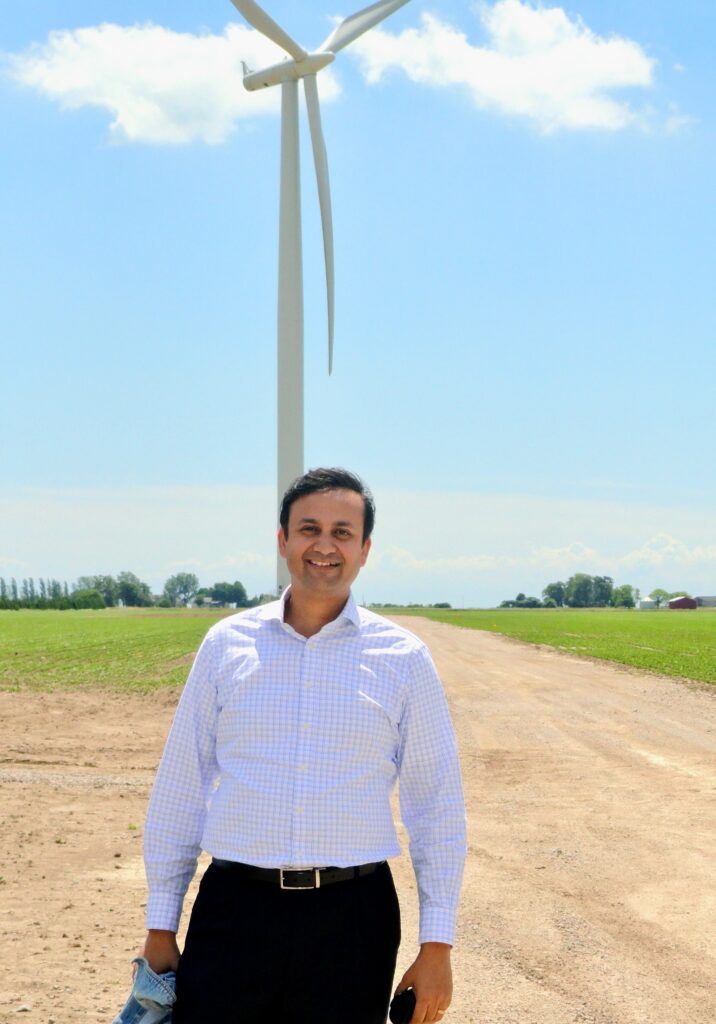
After Cambridge, he initially trained as a chartered accountant at KPMG and then joined the corporate finance department at Deutsche Bank to start specialising in his long-term interest area: the infrastructure sector. In the aftermath of the financial crisis Joy moved to New York. It was an all-time low for investment banking, but for Joy it was an opportunity – he was tasked with rebuilding the Deutsche Bank infrastructure franchise in the Americas.
It was, however, also the beginning of a revolution in the energy sector in the United States. Incentives for renewable energy promoted the development of solar, on-shore wind and later, off-shore wind. These were some of the most capital-intensive projects of the time and Joy and his team played a central role in many of these financings.
Now, as Global Head, Real Assets & Trade Finance Syndication at Natixis CIB in New York, he has found himself once again at the centre of a new boom – mobilising investment for digital infrastructure, specifically data centres for artificial (AI) intelligence, and the energy sources that power them.

“When you finance the construction of infrastructure, you often find yourself at the forefront of a wave. Today that new wave is AI infrastructure – the data centres, chips and the power plants needed to run them,” says Joy. The amounts currently being invested in AI infrastructure, particularly data centres, are, he says, “mind boggling”. He explains: “Roughly 50 per cent of the economic growth in the US last year is attributable to infrastructure investment in AI. In 2026 in the US there will be more than $400 billion of investment in AI; in 2025 it was probably around $320 billion.
“This is a truly global business with investment from every part of the world funnelled into these mammoth projects (the largest last year required $38 billion of debt). Structuring them and mobilising capital requires a lot of thought and crystal ball gazing – anticipating liquidity, analysing the credit concerns of potential funders, and trying to anticipate macroeconomic and geopolitical shifts that could prevent completion.”
In this regard, Joy has to have a strong understanding of private capital and its sources. “Since, by definition, these are areas where information is not widely available, you really have to be in the flow,” he says, “which means a lot of connectivity with market players, deep knowledge of deals, understanding of risks, and of the financial structures. My work is about securing financing from sources like banks, life insurance companies, pension funds and various asset managers all over the world.”
Adjacent to these large data centre projects are urgent plans for new energy infrastructure to power them. “These data centres are huge power hogs. In fact, you measure the size of a data centre by its energy consumption,” he says. “Right now, the big concern is whether we will run out of power sources for them. There are genuine fears for instance, in northern Virginia, which is a data centre hub, of ‘brownouts’, where the grid could break down due to excessive energy demand.”
The fastest way to build new energy supplies is to use renewables such as solar and wind power, but these can face political issues. “It’s far quicker to build a solar plant than a gas-fired power plant,” says Joy. “But geopolitics, ideology and the new trade tariffs imposed by the US are critical factors. China is a big producer of solar panels, but with the US tariffs other sources for panels have to be found. There are concerns about cost escalation and delays in many of these renewable energy projects, because of tariffs and supply bottlenecks.”
He added that wind energy projects have currently slowed in the US due to policy changes. In addition to gas-fired power, new sources of power such as nuclear fusion are now being explored. This brings him full circle to his time at Cambridge, when as a young physicist, he helped on the early research to develop power from controlled nuclear fusion at the Culham Centre for Fusion Energy. Perhaps, he hopes, he will now find himself at a new frontier – financing clean nuclear energy from fusion.