
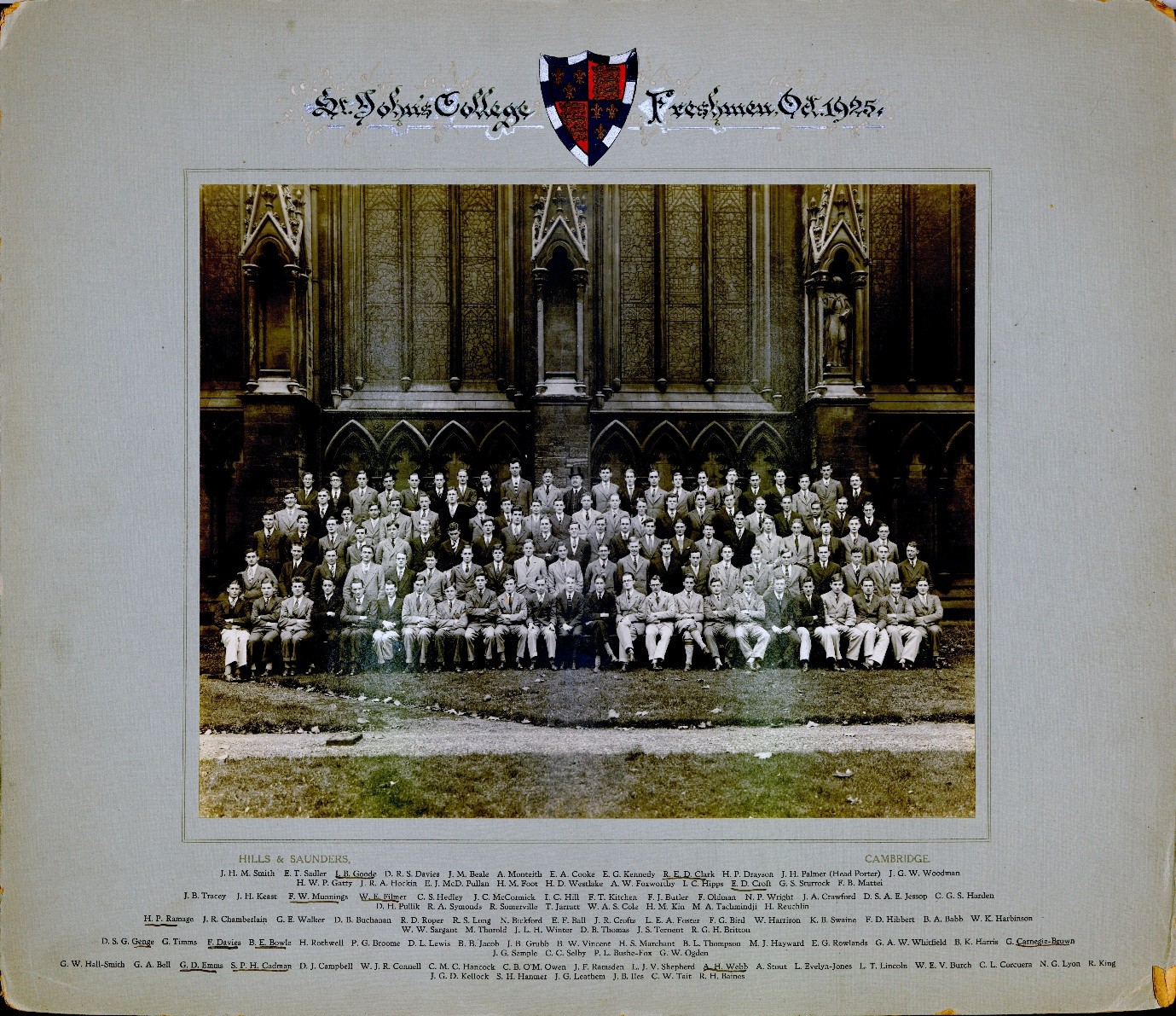
Travel back in time to Freshers’ Week 100 years ago
If you imagine Freshers’ Week these days to be a whirlwind of club stalls, parties and tours interspersed with digital inductions and admin tasks, cast your mind back a century and you will discover a different world. It was altogether quieter, more formal and overshadowed by the end of the First World War, but it still had a mix of tradition and excitement that any Johnian will recognise.
The freshers of 1925 were simply referred to as new men or fresh men (there were no women) and most arrived by train still recovering from the memory of the Great War. St John’s had sent 565 students, staff and alumni to go off to fight from 1914-18. Of the 163 killed, a fifth were under 21 and died before completing their degrees. During the War, the College had been a military base for training. In 1925, many freshers were somewhat older and matriculating later than usual, after general disruption to their education during the War and, for some, military service.
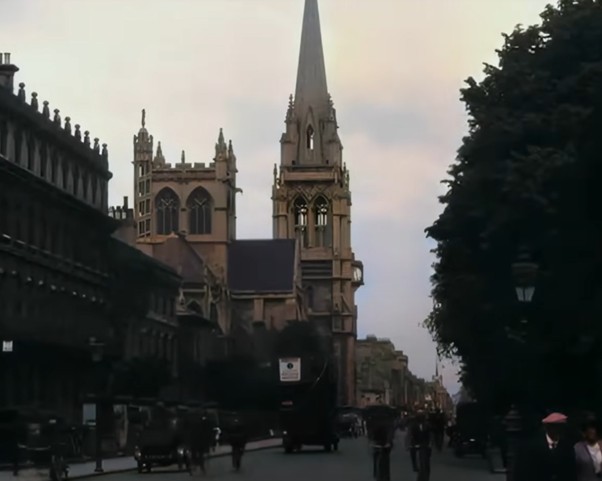
Living in College
New men were met by Porters and escorted up to their rooms. Accommodation was noticeably primitive when compared to today. Rooms were not automatically furnished and incoming freshers usually negotiated the purchase of items from their predecessors, sending home for additional items which would be despatched by train to College. Open coal fires provided heating although not in bedrooms, and bathrooms did not exist until the first bathhouse was built in New Court in 1922. Leather shoes, however, were worn as everyday uniform and were left outside the room for overnight cleaning by College staff. And on dress, suits were commonly worn and universally so on Sundays, together with hats or caps. Academic caps and gowns were required to be worn in the street after dark (which usually meant after dinner) and all day on Sundays. Those caught by ‘proctors’ outside without appropriate academic garb were fined 6 shillings and 8 pence – quite a high sum considering that a pint of beer would typically cost 5 pence.
Freshers arriving in 2025 enjoy fully-furnished rooms with high-speed internet connection, and access to a kitchen and free laundry facilities. They may dine in Hall or in the Buttery, Café or Bar for three meals a day and snacks when the mood takes them. Their 1925 counterparts had to order dishes from the kitchen at a price negotiated on a piecemeal basis, or fend for themselves other than taking their dinners in Hall.
Funding
John Sandwith Boys Smith was both an undergraduate and later Master of St John’s. He wrote in his Memories of St. John’s College Cambridge 1919-1969, published by St John’s College in 1983, about the financial constraints on some of the less well-off undergraduates: “My parents had sacrificed a good deal to send me to Cambridge… but I was fortunate to be awarded a scholarship by the College and a grant from the Naden Studentship Fund.
The scholarship and his parents’ money “went far towards meeting my Cambridge expenses. There were not, of course, at that time any mandatory grants to university students… the majority of undergraduates had to meet their own costs. There were wide differences in expenditure amongst undergraduates, wider I think than today. (i.e. in the 1980s). Some, no doubt were affluent, but more had to exercise careful economy. I had been able to keep my total Cambridge expenses within about £200 per year, and there must have been many who did the same.”
At a rough equivalent of £10,000 today, that would have been a tight budget indeed for all of an undergraduate’s costs.
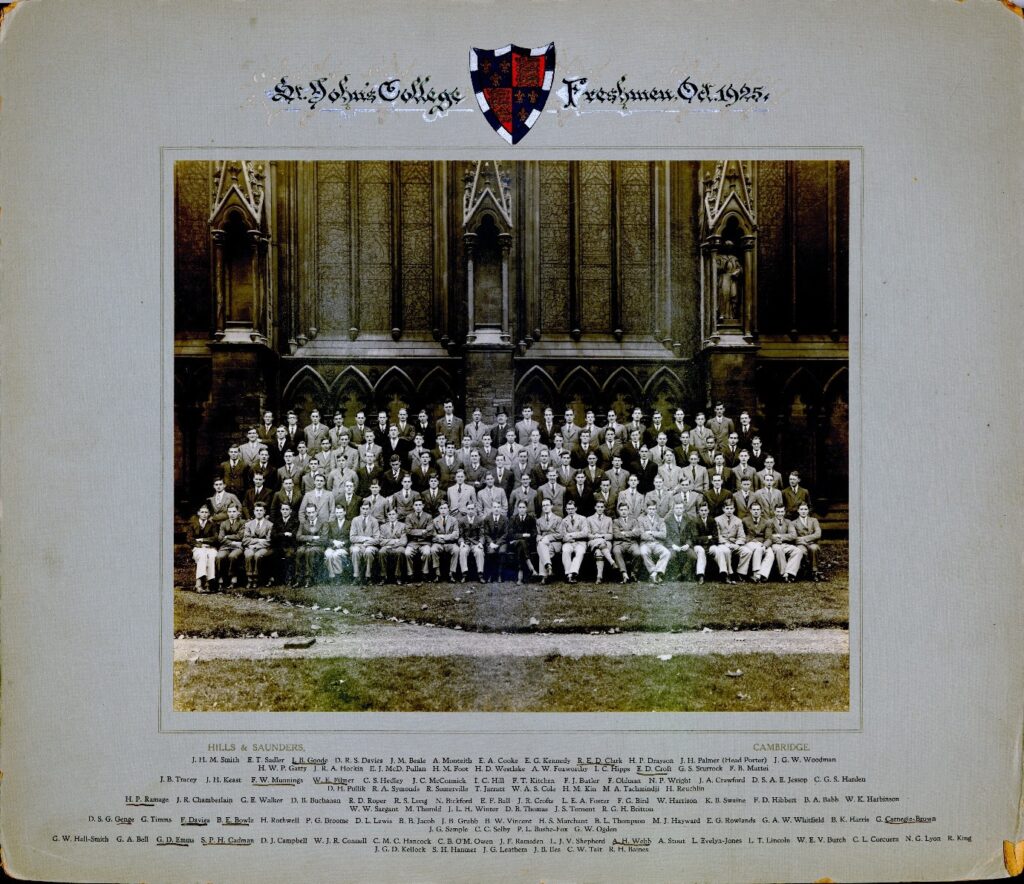
Dining
Dining in Hall was mandatory for undergraduates on at least five days a week. By signing out on up to two days a week students could be excused, but attendance was carefully monitored by Porters using an ancient system of ‘marking’ registers during dinner. The Porters were imposing figures in those days. Wearing frock coats, striped trousers and silk hats on formal occasions, they were considered the best dressed porters in Cambridge. Knowing every undergraduate by name and room number no doubt helped when hand-delivering mail to rooms as there was no system of pigeon holes in those days. The College population was much smaller too, reaching 450 students between the wars compared to more than 700 undergraduates today.
Chapel
A previously rigidly enforced tradition of compulsory attendance at Chapel services had ceased at the end of the Great War, but attendance was still recorded for the information of the Dean in the 1920s. Gown was required for Chapel, Hall and lectures.
Women in College
One obvious omission from this snapshot of St John’s Freshers’ Week a century ago is the absence of female voices, either as undergraduates, tutors or otherwise. While the Great War had won a level of suffrage for women in 1918 (those over the age of 30 who met minimum property qualifications), all women over the age of 21 would have to wait until 1928 to gain the vote. Women were not admitted to St John’s as students until more than 50 years later. After decades of soul-searching over the issue of “co-residence”, it was finally decided to admit women to St John’s in 1981. In 2025, of the 166 new students arriving in October, 40 per cent are female.
Who were the freshers of 1925?
Douglas Geoffrey Glenn Allen
He arrived at St John’s in 1925 to study Natural Sciences, not straight out of school, but after a period working with the London Scottish Assurance Company and the London Clerical and Analytical Laboratories. He was born in Ambala, India, the son of Colonel Sydney Allen, RAMC. He was tutored by the famous J M Wordie (Sir James), later to become Master of St John’s (1952-69), but Wordie’s more recent claim to celebrity in Allen’s day was as geologist and chief of scientific staff on Shackleton’s Endurance expedition in 1914.
Thomas Crawford Phemister (Professor)
Thomas came from Scotland to undertake research studies in Geology and subsequently forged a highly successful academic career in geology, petrology and mineralogy. He was appointed Principal and Vice-Chancellor, University of Aberdeen, in 1962.
Frederick Spencer Chapman
Chapman, who later became Lieutenant Colonel, matriculating at St John’s that autumn, would not have known that he would see military service in another world war, and endure imprisonment in Singapore. Fortunately, he survived, and his future children and grandchildren would also become Johnians. Frederick, who studied English/History at St John’s, was also tutored by Wordie, who may have inspired his subsequent career as a Ski Expert and Naturalist on the British Arctic Route Expedition (1930-31). He received many awards and honours, including those for his service with the Scots Guards in the Second World War.
Frank Oldham
Frank matriculated to study Natural Sciences, subsequently pursuing a career as a teacher of science, headteacher and Justice of the Peace. Frank understood the importance of taking a wider world view rather than staying within narrow tramlines of any discipline of study. His interests combined the sciences with philosophy and informed his publications about one such polymath: Thomas Young, Philosopher and Physician, 1933 and Thomas Young, Natural Philosopher, 1954.
Eric John Baxter Willey (Doctor)
Eric matriculated in 1925 to research for his PhD in Natural Sciences, after serving in the Lincolnshire Regiment in WWI. His later distinguished career as a physicist and academic was enriched by his involvement in the Cornwall Organists’ Association and the Choir of St Mary’s Parish Church, Penzance.
By Susan Burnett.
Sources:
St John’s College, Cambridge: A History. Edited by Peter Linehan
Memories of St. John’s College Cambridge 1919-1969 : Boys Smith, J. S :