

The engineer helping to turn the jet suit from fantasy into fact
Alex Maund (2015) is helping to pioneer the next generation of human flight with his work on jet suits for Gravity Industries
When Alex Maund watched a man strap five jet engines to his body, stand upright, open the throttles and rise into the air, he didn’t know he had just witnessed the direction of his future career. The first time he saw Richard Browning, the founder of Gravity Industries, demonstrating the jet suit, he was still an intern at Dyson. Browning had come in to deliver a talk and had also brought along the machine itself for a brief flight on the helipad. At this point, Alex admits he thought he was a “maniac”.
“I’ve got a video of the flight he did at Dyson, and it didn’t look very controlled when he was coming back down,” he says now, laughing. “It did look like he might crash. It’s definitely a lot more refined now than it was then, which is good. It was one of those moments where I thought, ‘That’s just insane. And obviously I’ll never end up working on something like that. It’s just too unique.’”
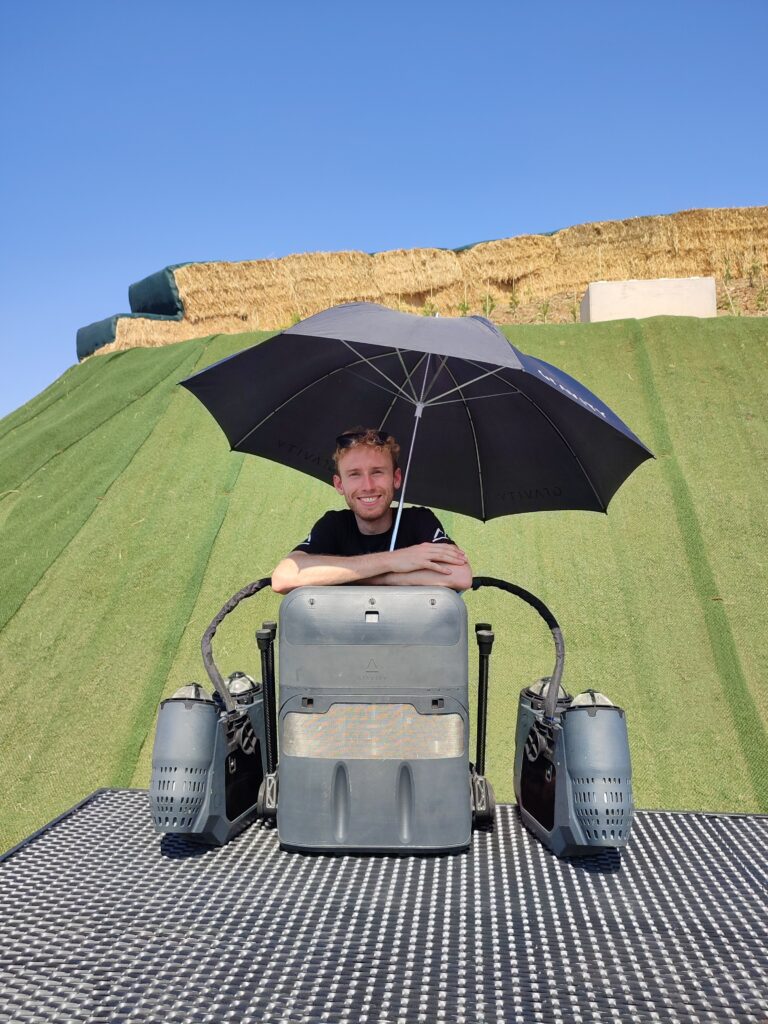
Alex was intrigued, though. And six years later, while working in technology consultancy and medical device development, he saw a post on Instagram. Gravity Industries, still tiny, was hiring one mechanical engineer. He applied, deciding to take a chance on something unusual. “I didn’t really expect to get it,” he says. He had been looking for a new job for months, but only half-heartedly. “I haven’t got a mortgage or children, so I thought I’d try and do something with a bit more risk which would be a bit different,” he says.
He got the job and has since become head of mechanical engineering and design, helping to transform the jet suit from an advanced prototype into a sellable product. His route to this role started with reading Engineering at St John’s. During the course, he focused mainly on mechanical and aeronautical engineering, graduating with a Master’s degree in 2019. Before starting work, he took time out for a ski season. Then came three years at TTP in Cambridge, a technology consultancy.
When he joined Gravity Industries three years ago, the company was still operating on a small scale. Since then, the operation has moved to a farm near Frome in Somerset, with 50 acres of land, a purpose-built office and workshop, and a training trench dug into the site to keep noise down during flights. The technical team has grown to roughly a dozen. There is now a production department, a roster of pilots and a commercial arm.
“My main job has been professionalising the equipment, basically taking it from an advanced prototype, to something that is a robust, usable, safe product. We’ve spent the last year nailing down everything,” he says. “We’ve got production manuals, we’ve got quality control stuff, testing. So we are now able to sell this commercially.”
On the latest suit, Alex says he has designed “probably 90 per cent” of what can be seen mechanically. Ownership of a project has been one of the pleasures of working for a small company. Naturally, he has learned to fly the suit himself. He describes flying the craft as similar to skiing or riding a bike. “We don’t really have any stability systems or gyroscopes,” he explains. “We just use human balance in the same way that you would on a bicycle. Quite a few of the pilots who fly for us are ex-GB gymnasts. They are very spatially aware in the air. They’re very strong for their weight, and they are quite lightweight. But it turns out, pretty much anyone can learn, to be honest. You don’t have to be an experienced pilot to fly this. You have some practice, and then it becomes second nature.”
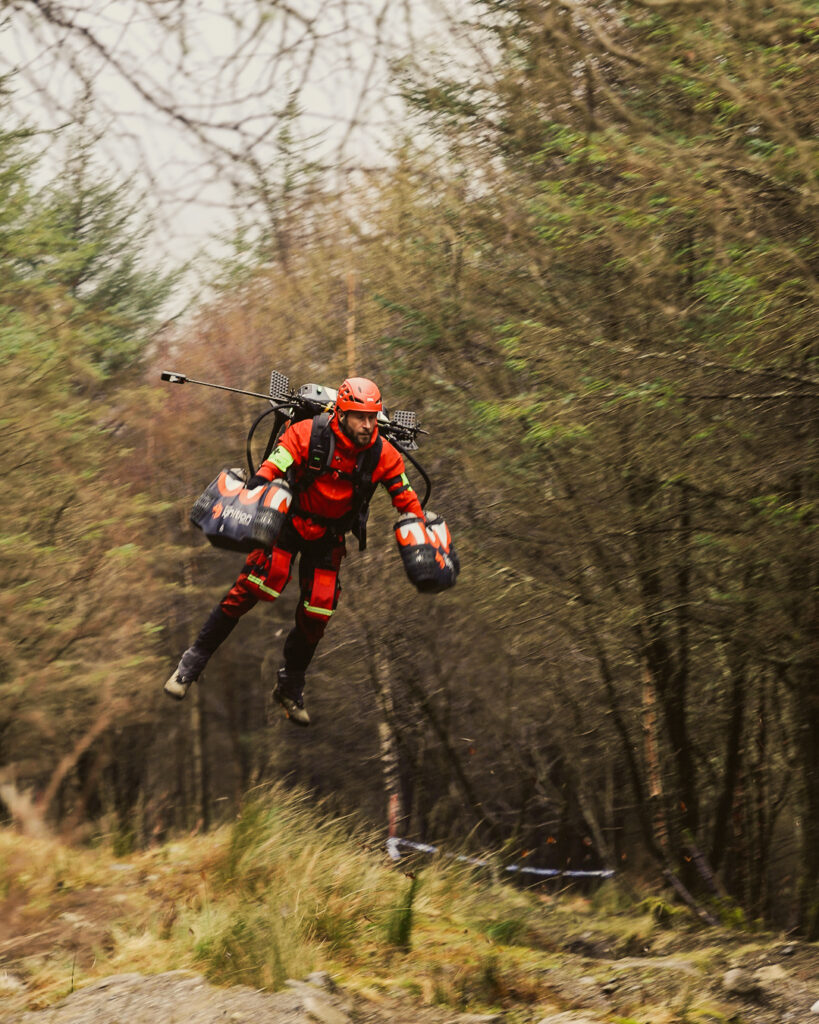
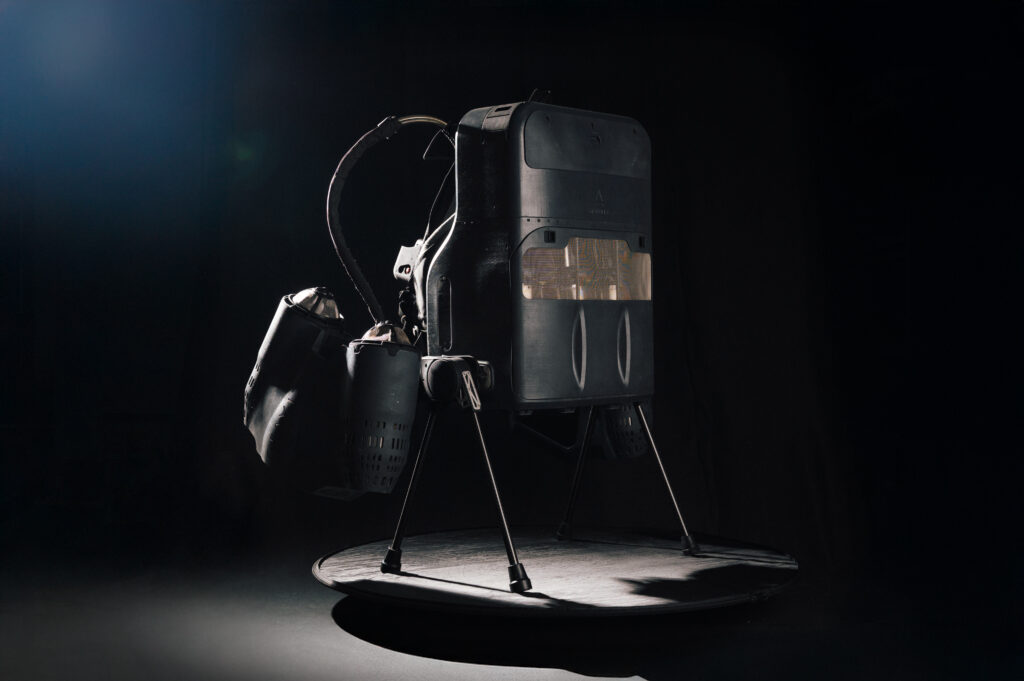
The jet suit has three micro-jet engines mounted on the backpack, which also carries the fuel, and two more on the arms. Together they produce more than 1,000 horsepower. Alex says: “I tried it in the first week of my job. The first sensation is force, heat, noise and raw power. On my first go I only managed about a minute in the air, but it was brilliant. If you want to go forwards, you point your arms backwards, and that rotates you forwards. If you want to go up, you push your arms together, which points more force downwards. Then if you point your arms outwards, you come down. But you can also adjust the speed of the engines. It’s all just balance. Most people can hover and fly around after a week or two of training.”
For several years, the company’s main business has been entertainment. It has flown at private events, technology conferences and brand launches. There was, he says, a birthday party for Jeff Bezos, another for SpaceX, and a launch involving the Kardashians. In Dubai, the company launched a race series, imagining the jet suit as a kind of airborne Formula One. Wealthy civilians can pay to try flying under supervision at training sites in Britain and California. It is a viable business, and a glamorous one. Yet Gravity’s greater commercial ambitions lie elsewhere, in professional applications where the suit’s speed and agility might matter far more.
One major application for the suit is maritime and defence use: moving swiftly from boat to boat or boarding a larger vessel from a smaller one. Alex has taken part in European exercises simulating pirate hostage situations, in which the suit has been trialled as a rapid insertion tool for specialist teams. At sea, a jet suit can bridge the final gap faster and more flexibly than conventional methods such as ladders or grappling hooks.
People often ask how high it can go or how long it can remain airborne, but those questions rather miss the point. This is not, he insists, really an aircraft in the usual sense. “There’s no reason to go high in this thing,” Alex says. “You’re trying to get from A to B, and there’s no point going up, along and down. We’re not going Trans-Atlantic. It’s more like a quad bike that can go over anything rather than a typical helicopter or aircraft.”
Although the jet pack is very simple to use, a person with a backpack of jet fuel and engines emitting 800C air is not engaged in a risk-free activity. Yet the company’s safety record is better than many outsiders assume. In seven years, across thousands of flights in dozens of countries, the worst injury has been an injured ankle.
In most operations over land, flights are kept to just three to five metres above the ground. Over water, pilots can go a little higher. “It’s fine to go higher over the sea as it’s not going to be quite as bad if you have a problem where you go into the water rather than fall on land, and the equipment also floats. It’s really good for moving from one boat to another, but even so you don’t need to get higher than 10 metres.”
Another potential use is emergency response. In mountain rescue a team might take 45 minutes to reach a casualty on foot, while poor weather can ground helicopters. A jet suit pilot could potentially make the journey in two minutes, carrying essential kit such as a defibrillator. The jet suit is going to be trialled later this year in real mountain rescue callouts. The same logic applies to avalanche rescue or remote casualty response.
The difficulty, at least in Britain, is that many rescue services are charity-funded and cannot simply purchase new high-cost equipment. “One hope is that our commercial sales could help support that work,” he says.
As for his own future, Alex is wary of over-planning it. He looks forward to seeing how the company and job changes and where things take him. At the moment, he is designing a bigger version of the suit along with progressing many areas of the company as they become an equipment supplier. “It will be able to carry heavier people or extra kits, such as oxygen tanks, but not a second person,” he says. “This would be helpful for medics in first response, for example in an avalanche, where they can get there really fast and land anywhere and quickly administer healthcare. But then the helicopter would be the machine that takes people out.”
Reflecting on his journey to this point, Alex credits his time at Cambridge and St John’s with helping to set him on the right path. “I really enjoyed my time there. My degree in engineering taught us so much about all the different disciplines that it really set us up really well for working in a fast-paced multi-disciplinary startup. I was also involved in so many conversations that added value in all the different areas, whether it be electrical or software, even though my main specialism is in mechanical and aeronautical engineering. And, of course, I made friends for life.”