Swasthi Surendran
(2020) Engineering
The Leonardo Award for Engineering and Science
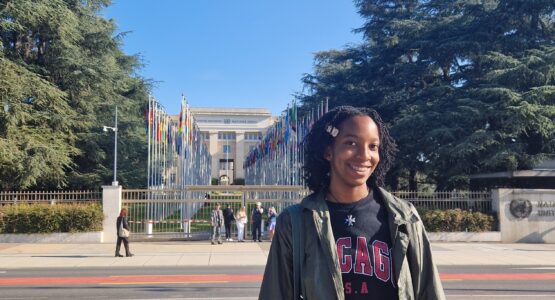
Swasthi Surendran completed her BA and MEng at St John’s, specialising in civil, structural and environmental engineering, then took the MRes. Her fourth-year project was supervised by Professor Janet Lees, with whom she has now begun her PhD in the Future Infrastructure and Built Environment Centre for Doctoral Training (FIBE3 CDT Cohort 1). Here, she summarises her challenging yet rewarding research.
Concrete is the most versatile construction material. It is incredibly strong and very cheap, and it starts off wet, meaning it can be poured into any shape, where it solidifies not too quickly and not too slowly. So why would we use anything else? The environmental impact of producing concrete is significant – 8% of all anthropogenic CO2 emissions are due to concrete, with quarrying limestone and dredging for aggregates also negatively impacting biodiversity.
In order to reach net zero, it is important to reduce carbon emissions associated with the production and use of concrete. This can be done by reducing the sheer volume of concrete we use and by replacing some of the cement content with lower carbon materials.
The main barrier is not a lack of innovative solutions; it’s the implementation of these new technologies. This is mainly because they further compound the uncertainty already inherent in the life of concrete. Thus, mitigating risk is an important endeavour.
Changing concrete to have less embodied carbon alters what we define as concrete. The chemical and microstructural behaviour also changes, which can significantly alter concrete’s performance, such as its strength. A result of this broadening definition of concrete is that many of the relationships and standards we currently have are unable to account for these changes in behaviour and the induced risk.
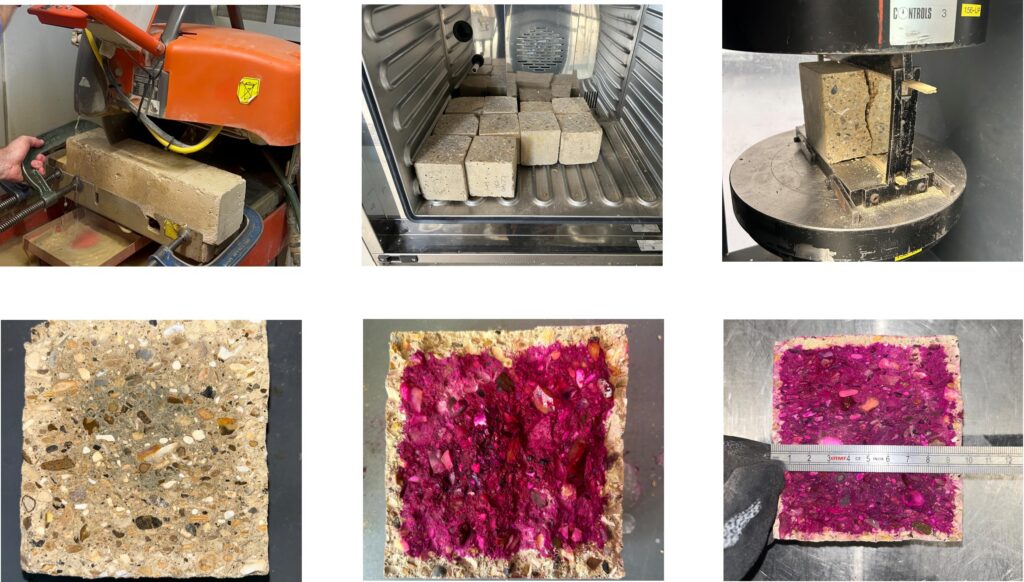
It is therefore more important than ever to push the boundaries of traditional safety factors and relationships, focusing on two techniques: (1) significant experimental testing to explore how changing materials can change the performance; and (2) analyticalmodels to predict performance. Combining both experimental and analytical work is a good way to overcome the challenge of novel materials being used in concrete.
My research looks at how we can predict the properties of concrete in this way. The use of embedded sensors in concrete (which can monitor the internal temperature profile, for example) may reveal more about its chemical, thermodynamic and microstructural development. Combined with experimental testing, this can enable better understanding of implications for performance, reducing the need for conservative safety factors. In turn, this would reduce waste through a more efficient and reliable use of materials.
The Leonardo Award has allowed me to learn about the subject more freely. In May I presented a poster titled “Performance-based investigation of a ternary concrete blend” at the Institute of Concrete Technology’s 53rd Annual Conference. This gave me the opportunity to present work I had completed during my fourth year at Cambridge about how the cost of reducing embodied carbon is reduced performance – and on identifying thresholds during which the inclusion of these low carbon materials is worthwhile.
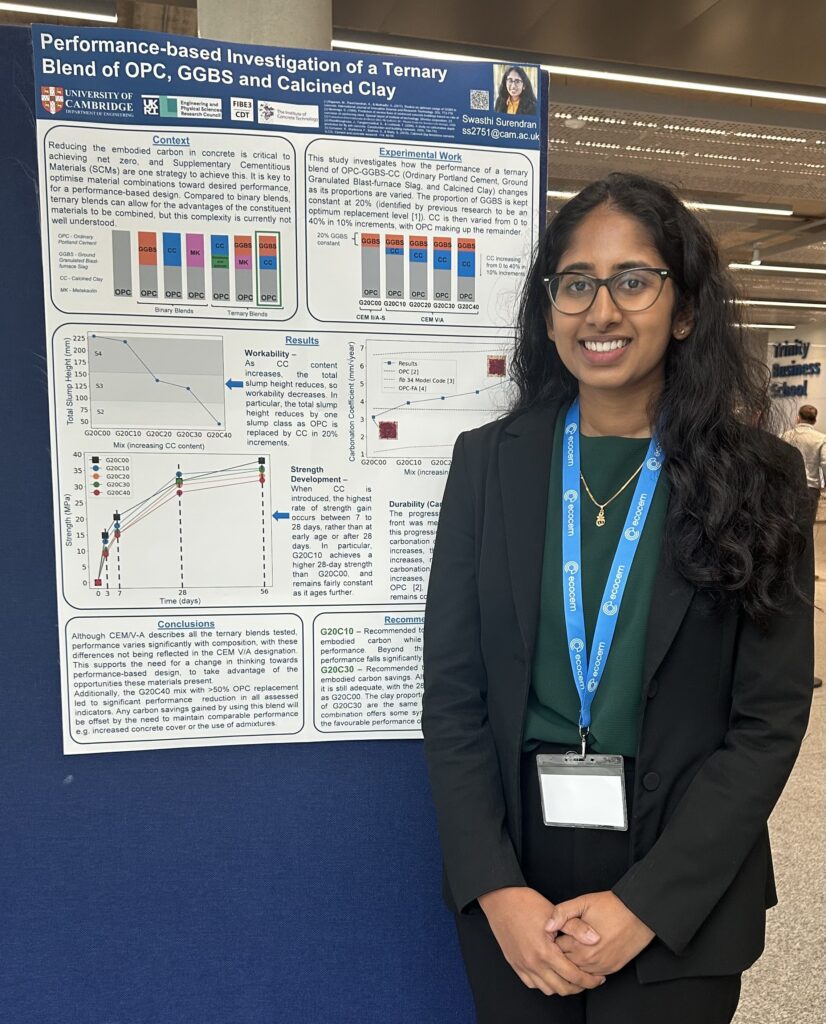
Conference feedback from both industry and academia was valuable in shaping my research direction. Where industry was mostly focused on strength development, academia was interested in the material chemical composition. This resulted in my PhD investigating how varying chemical composition can affect the strength development.
Thanks to the support offered by the Leonardo Award, I was able to usefully network and even attend the conference dinner in the formal hall of Trinity College Dublin. I subsequently spent time in the beautiful city of Dublin, which was a great experience. The award has also allowed me to attend conferences, seminars and webinars out of interest, to learn about the field more broadly and the needs of structural engineers. Understanding the problem space then helps me plan my research with its final impact in mind.
Having only previously made concrete in small batches in the lab, it was shocking to see the sheer volumes and rate of concrete production when I visited a Capital Concrete plant in London. The mixer had a volume of 8m3, and one of these batches was being sent out continuously, supplying construction projects in East London. Although all the physical work was automated, it was surprising how much judgement was made through experience, such as a visual inspection of a mix to deem it needed a bit more water. Since construction is such a traditional engineering discipline, it is important to bear in mind that confidence must be given to the people on the ground in order to build structures well.
Other funding sources: UKRI EPSRC FIBE3 CDT (Centre for Doctoral Training in Future Infrastructure and Built Environment)