

Falling in love with the problem: Key takeaways from entrepreneurs’ panel
Five alumni entrepreneurs shared their lessons from building and investing in ventures that address the world’s most urgent environmental and social challenges at a St John’s College panel discussion.
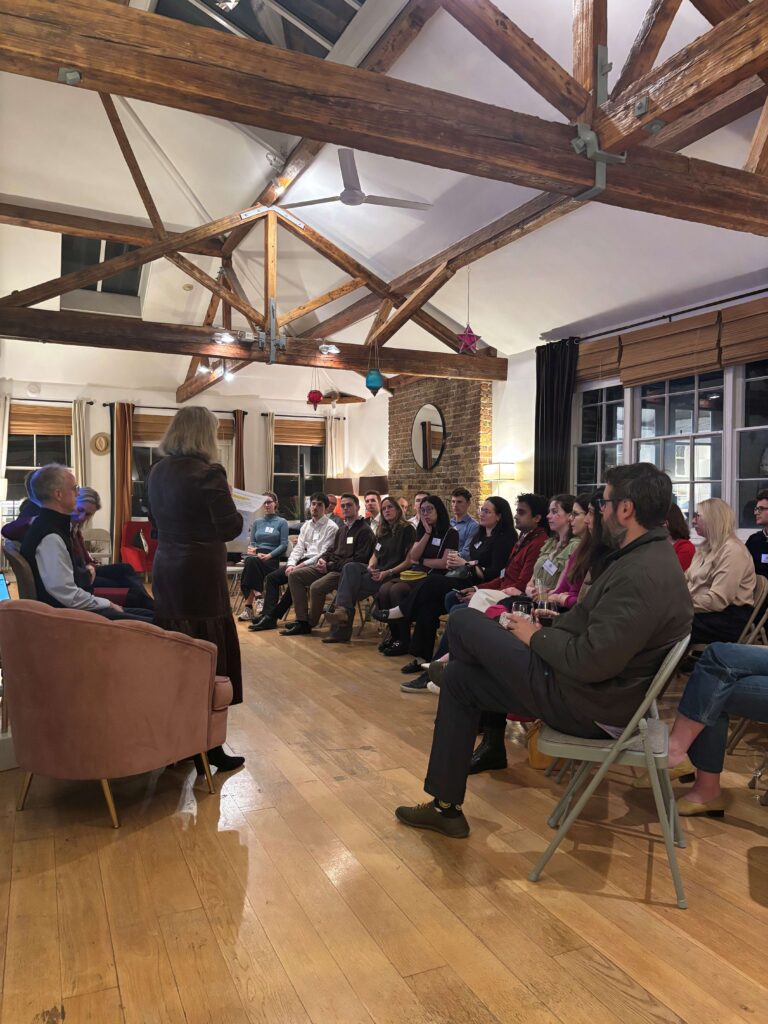
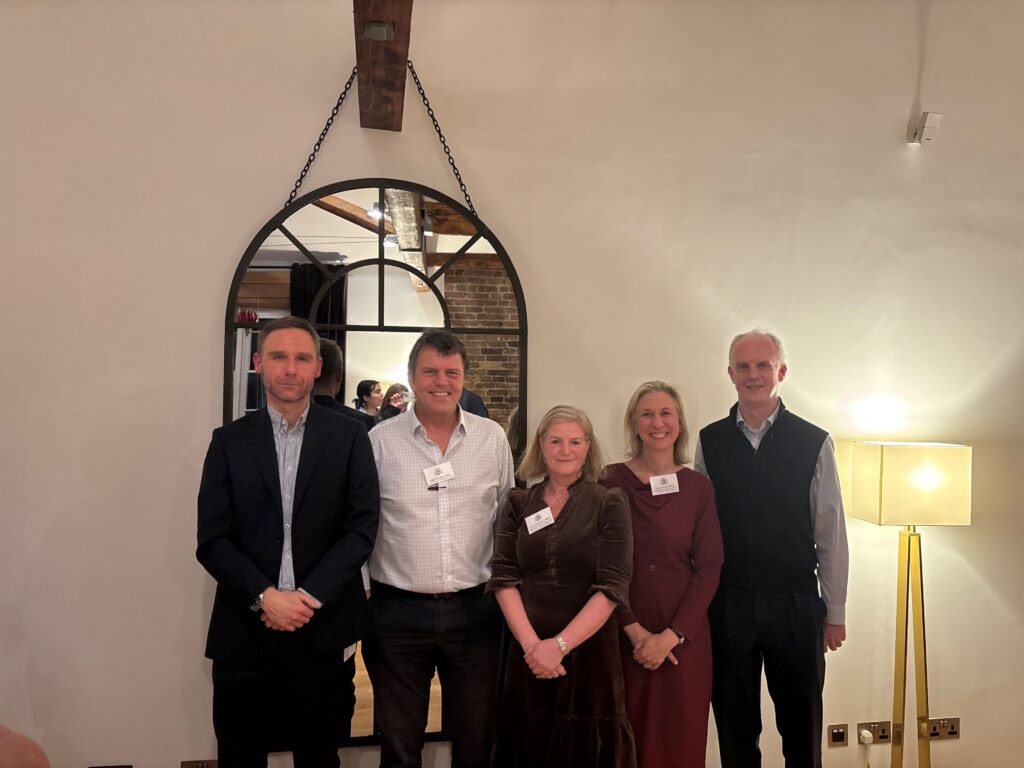
The networking event, held at Shoreditch Loft in London this month, titled Turning Ideas to Enterprises: Johnian Journeys in Sustainability Entrepreneurship, included panel members Lucy Carver (1994), Tuomas Knowles (2004), Ian Simm (1985) and Nigel Topping (1985), and it was chaired by Lucy Carmody (1985).
From science‑based innovation and investment strategy to systems thinking and personal resilience, the panel demonstrated that entrepreneurship in sustainability is as diverse as it is urgently needed. Their experiences, gained in decades of work across academia, industry, finance, NGOs and policy, form a map of the many possible journeys into impact‑driven enterprise. The evening featured insights ranging from where to find investment and how to decide on the amount of risk to take, to collaborating with peers and even competitors.

Start by understanding your path and motivations
Chairing the panel and reflecting on her experience founding an ESG research company, Lucy Carmody encouraged aspiring entrepreneurs to reflect deeply on their long‑term career trajectory. She said: “Careers are getting longer and can include many twists and turns. Think carefully about which part of your career you’d like to dedicate to ‘service’, ‘entrepreneurship’ or ‘innovation’, if at all.”
She highlighted that experimentation is valuable: “Some may prefer to spend a few years at the start of a career exploring and testing options, building experience within NGOs, start-ups and scale-ups.”
Others, she noted, might take the opposite approach: “Others may find it easier to delay, and ‘scratch these itches’ later on in your career, once you have the comfort of savings and have settled in one place.”
And she underscored the importance of support systems: “If you chose to be an entrepreneur, it truly helps to have a solid partner – either in life, in business or, preferably, both.”
Fall in love with the problem and learn to speak many languages
Co‑Founder and Co‑CEO of Ambition Loop, Nigel Topping, stressed the mindset required to create meaningful change. He advised entrepreneurs to begin with purpose, saying: “Fall in love with the problem you are solving.”
He also emphasised the need to adapt your communication. He said: “Become multilingual – if you cannot speak the language of your investors, customers, staff and suppliers so that you engage with each in language they understand, you will struggle.”
And he urged openness to all forms of entrepreneurial work: “Be open to multiple entrepreneurial routes. Your own start-up, joining an early stage business – including innovation in policy making, social enterprises, NGOs – all require courage, agility and relentless pursuit of the next funding round!”
Finally, collaboration is not optional, but rather key. He explained: “Practice radical collaboration – every significant innovation requires a systemic approach.”
Communicate clearly and don’t overuse jargon
As Founder and Chief Executive of Impax Asset Management, Ian Simm offered practical advice on investment readiness. He emphasised that funding is out there, provided entrepreneurs can articulate a compelling vision: “If you’re ambitious and communicate a compelling plan well, there’s plenty of investment capital out there, but you may have to get on a plane to pitch to it.”
He also challenged the assumption that entrepreneurship requires reckless risk‑taking: “To be an entrepreneur you don’t necessarily need to gamble everything to try to make your dream come true – when choosing your venture, decide how much risk you want to take as you channel your passion for leadership, innovation and disruption.” And he warned against narrowing your audience with overly technical language, saying: “Don’t hide behind jargon. If you frame your pitch as ‘green’, ‘sustainable’, ‘impact’ or similar, you’ll probably narrow your appeal to investors. Instead, try to use more everyday language such as ‘more efficient’ and ‘less polluting’.”
Build strategy from understanding your dependencies
As Co‑Founder of Ochre Partners, Lucy Carver urged entrepreneurs not to think of sustainability as an add‑on, but as strategically central. She said: “Understand how your business is materially exposed and where the value opportunity is, and build your strategy from that.”
She highlighted key dependencies, such as water, minerals, labour markets and supply chains, and encouraged asking what the opportunities are and what the risks are. Once you work through that, she says, “You find yourself talking not about sustainability but about core business strategy, risk and value creation.”
She also stressed the importance of holding the long view while delivering today, and balancing vision with practicality. She said: “The most effective sustainability entrepreneurs … never lose sight of the scale of the transition they are working toward, but they are equally disciplined about managing short-term trade-offs, building consensus and delivering tangible results along the way.” She concluded with a reminder of the resilience required: “To succeed you have to take risks and experiment, which will sometimes mean failure. That is the price of working at the frontier of something important. Learn fast and go again.”
Professor Tuomas Knowles, Fellow at St John’s College and founder of five spinout companies, reflected on the immense value of applying fundamental science to help solve real-world problems, and the advantages Cambridge offers for launching new ventures. He said: “Start. Cambridge offers one of the strongest environments in the world to build a company – exceptional ideas, talent and access to experienced investors”.
For St John’s students and alumni exploring these paths, the message was clear: start with purpose, collaborate relentlessly, communicate clearly, understand your risks and don’t be afraid to start again.