Dr Christina Faraday reveals the secrets of Tudor art in her new book
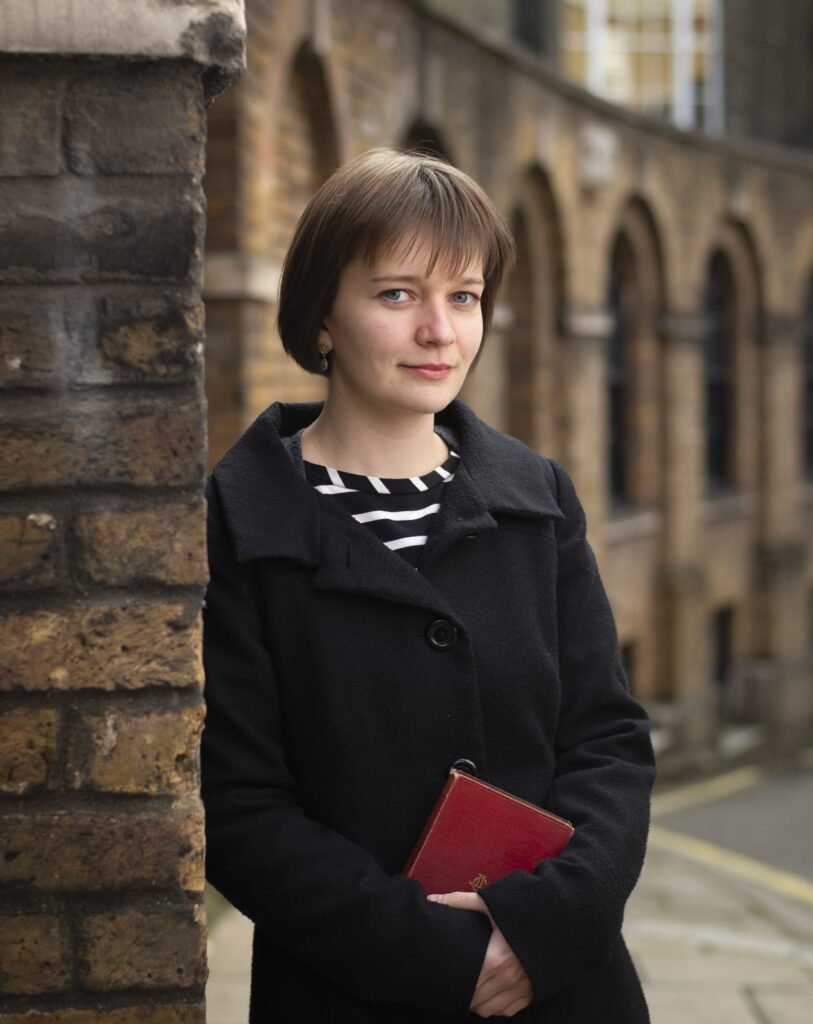
From trousers so outrageous the wearer arrested to the object no Tudor home was complete without, Dr Christina Faraday (2011) has a wealth of fascinating insights in her new book, The Story of Tudor Art. She is an Affiliated Lecturer in the History of Art Department at the University of Cambridge and has curated a new exhibition, Tudor Contemporary, at the Heong Gallery in Downing College that opened last week. We caught up with her here.
Why did you write your new book, The Story of Tudor Art?
When I studied Tudor art for my PhD at St John’s, people would ask me, “What’s the one book I should read on Tudor art?”. And amazingly, there wasn’t one. There was no single book that covered enough of a variety – tapestry and portraits and royalty and normal people and all of the rest of it. So I thought, well, I’ll write it.
What do people mean by Tudor art?
We tend to think of portraiture as being the most important genre from Tudor England, especially artists such as Hans Holbein or Nicholas Hilliard. But for the Tudors themselves, portraits were really not a significant genre at all in terms of value. They really valued art for its ability to communicate and also for the materials that it was made of. Tapestries were actually the most valuable art form financially. Some were made using real gold and silver threads. They can come in sets of eight or 12, they fill whole palace rooms, they tell a narrative from start to finish. It’s like a movie but in textile form. Those were the things that the Tudors really valued.
Why were portraits seen as less important?
Portraits were only valuable as long as you could remember who was in them. And if you forgot who was in them, it didn’t matter if it was by Holbein, you’d be, at best, putting that away in your attic. There are stories at the end of the 16th century, when this idea of valuing an artist as a skilled person whose name you might look for was creeping in, about people competing to find Holbeins in attics and in forgotten corners of houses. It’s a really very different attitude to art than today.
What messages were the Tudors trying to communicate?
For royalty, things change between reigns. The Tudors, in particular, didn’t have a very strong claim to the throne. Henry VII is really the first monarch who sees the potential of visual art for the branding of his family. Historians of the 20th century used the word propaganda a lot because they were living through the Cold War, and they saw things in those terms. I think that gives a bit too much of an impression of centralised, authoritarian control, and I don’t think the Tudors had that. I think it was all a little bit tentative and piecemeal; it’s not some overarching design. But I think Henry VII uses things like portraits, coins and tapestries to communicate certain ideas about his reign.
How did Henry VII want to be seen?
He has a set of tapestries of Vespasian, who was a Roman Emperor known for having ended a period of civil war. Henry VII, coming after what we now call the Wars of the Roses, I think, was comparing himself to Vespasian. He’s also the first monarch to put his actual face on coins. Before that, it was a generic representation of a king. He understands the power of associating himself with the money, even though most people won’t see the money because they bartered their goods. But the fact is this kind of official government-issued precious metal has his face on it. I think he sees the power of that for asserting his right to rule.
What does Henry VIII try to say through his art?
Henry VIII likes to compare himself to King Arthur and other romantic knights. He commissions the repainting of the Round Table at Winchester Cathedral, which was thought to be the round table used by Arthur and his knights. Also, politically, he’s trying to rival France and the Holy Roman Empire. It’s not clear that Henry really understood what we would now understand about the Renaissance, this overarching rediscovery of the ancient world, but instead he saw as a kind of style choice, classically inspired grotesques and trophies of arms on interior decoration; he embraced that, and he tried to poach craftsmen from abroad.
What is art like after the Reformation?
Particularly in the ‘80s, there was a strong scholarly narrative that the Reformation meant an end to art in England, except occasional portraits, and that people were afraid of having art because they were afraid of committing idolatry. But it’s not as sudden a change as we might think. Of course, the biggest changes were in parish churches and in the dissolution of the monasteries. Where those places used to be full of statues and wall paintings and votive imagery, they were largely whitewashed. The commandments were written on the walls, but basically no images were allowed. However, in people’s houses religious images never really went away. They just changed slightly.
Which religious images were popular in homes?
Before the Reformation, you’d have images of Jesus, and another very popular kind of image was a sculpture of John the Baptist’s head on a platter. It seemed every home should have one! Then after the Reformation, you get much more emphasis on Old Testament imagery like the sacrifice of Isaac by Abraham. That is what theologians call a ‘type’ for Christ’s crucifixion. So it’s a way of having a picture that reminds you of Jesus without having to navigate the rather difficult issue of how to represent Jesus. Religious imagery never goes away completely, but it does change in terms of its acceptability, and you see it more in what we would call decorative arts such as plasterwork and wall paintings –things that are sort of incidental to a room, rather than having a standalone sculpture that is the focus of worship.
Which objects in your book do you think will most surprise people?
I talk a bit about sumptuary laws, which were rules that governed what you could wear according to your rank. And there’s a story about a man called Richard Walweyn who was arrested for wearing ‘a very outrageous and monstrous great pair of hose’. We’re not really sure what they looked like, but they may have been very bulbous or inappropriately padded, and he had to hand them over to the authorities. Sadly, we don’t have a picture of them, but they were displayed in public as an ‘example of folly’. I would love to have seen them.
Is that the one piece of lost art that you want to see more than any other?
Perhaps it’s a tie, between that and a great house called Theobald’s in Hertfordshire. It was destroyed in the 17th century, but it was built for Elizabeth I. In one of the halls was a ceiling representing the sky, with some kind of mechanism that made the sun and the moon travel across it during the day. There were holes in the ceiling and lamps were put behind it, so it looked like the stars were twinkling. It sounds like an amazing piece of mechanical magic. Sadly the house was very strongly associated with the Crown – James I made it one of his permanent residences – so as a result, during the Civil War, the Parliamentarians thought it was too much of a symbol of royalty, and they pulled it down. But the ceiling had gone by then anyway, so even if it had survived, we’d have lost the ceiling.
What do we know about the art belonging to St John’s College’s founder, Lady Margaret Beaufort?
I start the book with her, with a trip to the College archives to see her inventories. They are such interesting documents. They say a lot about her surroundings at the end of her life, which were sumptuous and just totally plastered with Tudor symbols everywhere, on bed covers, curtains, hangings, upholstery: everything said ‘the Beauforts, the Tudors, have arrived’. There were roses and portcullises, lots of symbols that will be familiar to Johnians. But the documents themselves also give a fascinating insight into what that process of probate inventory must have been like. There are smudges and thumbprints, parts where somebody is trying out their pen in the margin. You can imagine how after Lady Margaret died everything had to happen very quickly, to value her goods and decide what would be sold and what would be absorbed into Henry VIII’s collection. It was probably quite a hasty process. You can imagine them bustling around and writing it all down.
What kind of art did ordinary people have?
In this period there’s a new middle class of professionals, lawyers, scholars, merchants, and they are commissioning portraits for the first time. Portraiture is a relatively recent phenomenon, but a few decades after it starts, merchants get in on the act, and they start commissioning portraits of themselves. And then, whereas for the royal court tapestries are a really important feature, with gold and silver thread woven into them, cheaper versions were available for people lower down the social scale. The cheapest version was a painted or stained cloth that imitates tapestry. There are just a couple of these surviving because they were used until they fell completely apart. In Ipswich, there is a painted cloth of Hercules slaying one of the beasts. It is clearly inspired by changes that are happening in tapestry design at the same time. So even if you couldn’t afford a tapestry, you’re still getting a similar kind of aesthetic.
Where should people go to see Tudor art outside of major galleries?
Hardwick Hall in Derbyshire is probably the best place. It has the most complete surviving Tudor interior, because the family didn’t have enough money to do anything drastic to Hardwick Hall for centuries. The plasterwork and tapestries are all still in the rooms that they were in when Bess of Hardwick built the house in the 1590s. And it’s just a lovely mixture of materials and objects. In the High Great Chamber there’s a plasterwork frieze representing a forest. It has political symbolism – the goddess Diana is there, and that’s a tribute to Elizabeth – but it’s also just nice to live with. It would be a very restful, harmonious room to spend time in.
What’s next for you?
I’m curating an exhibition at the Heong Gallery in Downing College called Tudor Contemporary. It riffs on the Epilogue of my book, looking at some contemporary artists who are inspired by Tudor art. Many artists are really interested in the Tudor period as a way of addressing ideas about history and artistic artifice. One of my favourite pieces is Mat Collishaw’s Mask of Youth, an animatronic face of Elizabeth I. It’s an attempt to imagine what Elizabeth looked like at the age of 55, in the year of the Spanish Armada. Portraits of her from that time generally make her look much younger than she was. Collishaw used less biased accounts from foreign ambassadors, medical information and other imagery to try to recreate her actual appearance. However, the exposed robotic armature reminds us that this image is as artificial as any 16th-century representation of Elizabeth.
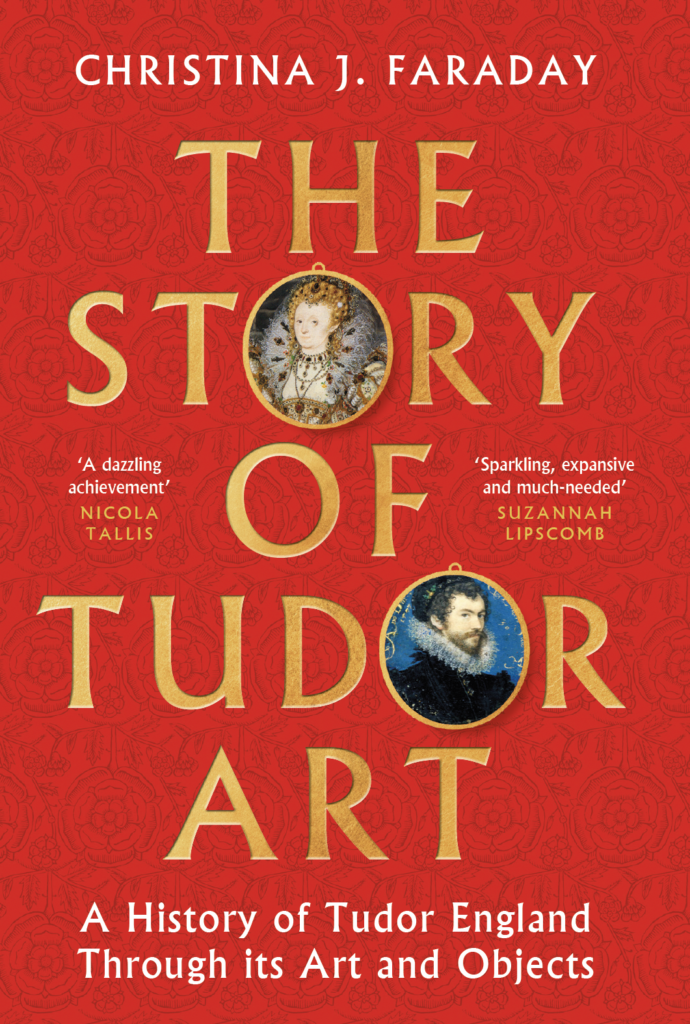
The Story of Tudor Art is published by Bloomsbury.
The Tudor Contemporary exhibition is at the Heong Gallery in Downing College, Cambridge, until April 19.
I
Listen to a podcast featuring Dr Faraday discussing her new book with Professor Suzannah Lispcomb.