
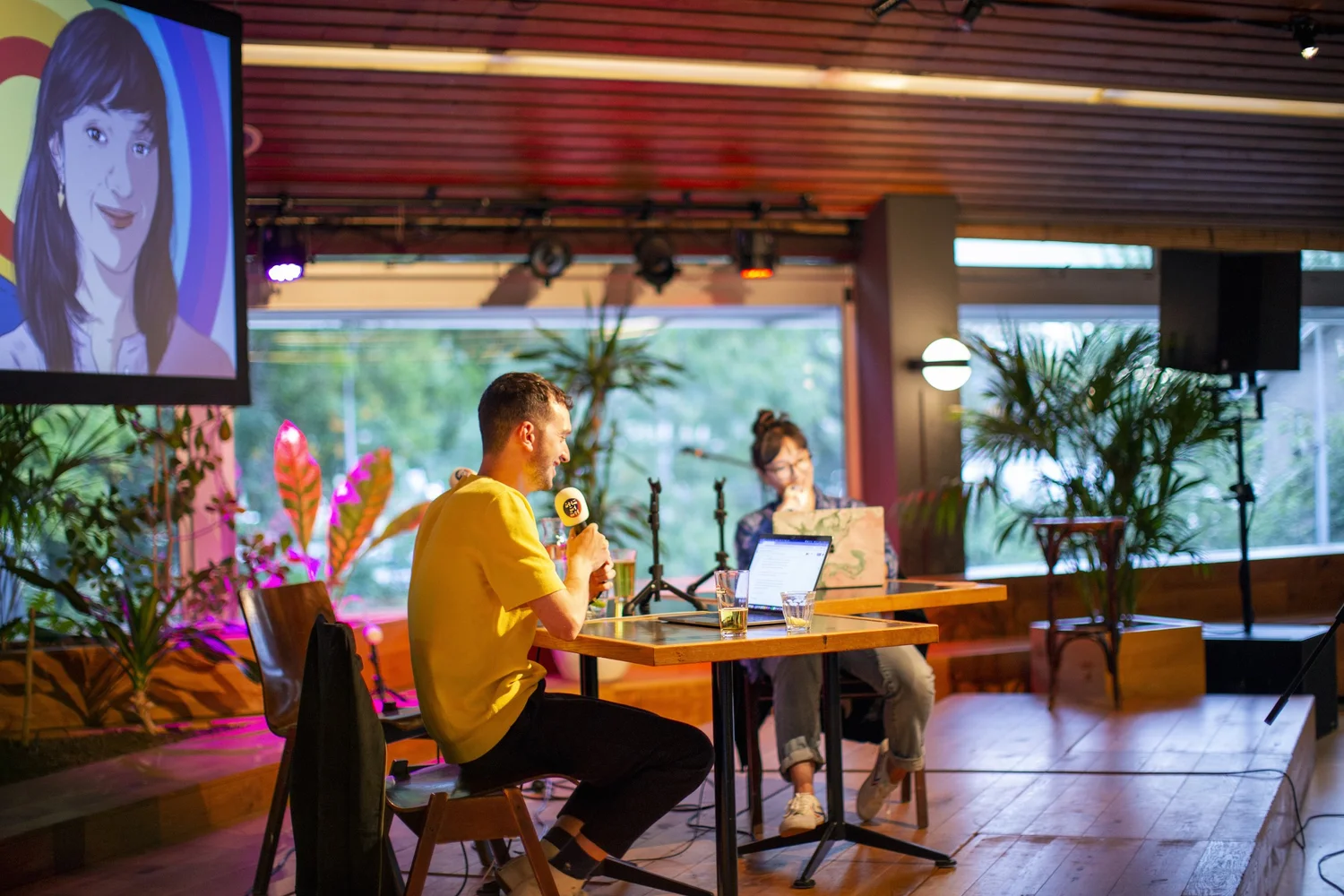
Two Johnians and one podcast featuring Europe beyond the headlines
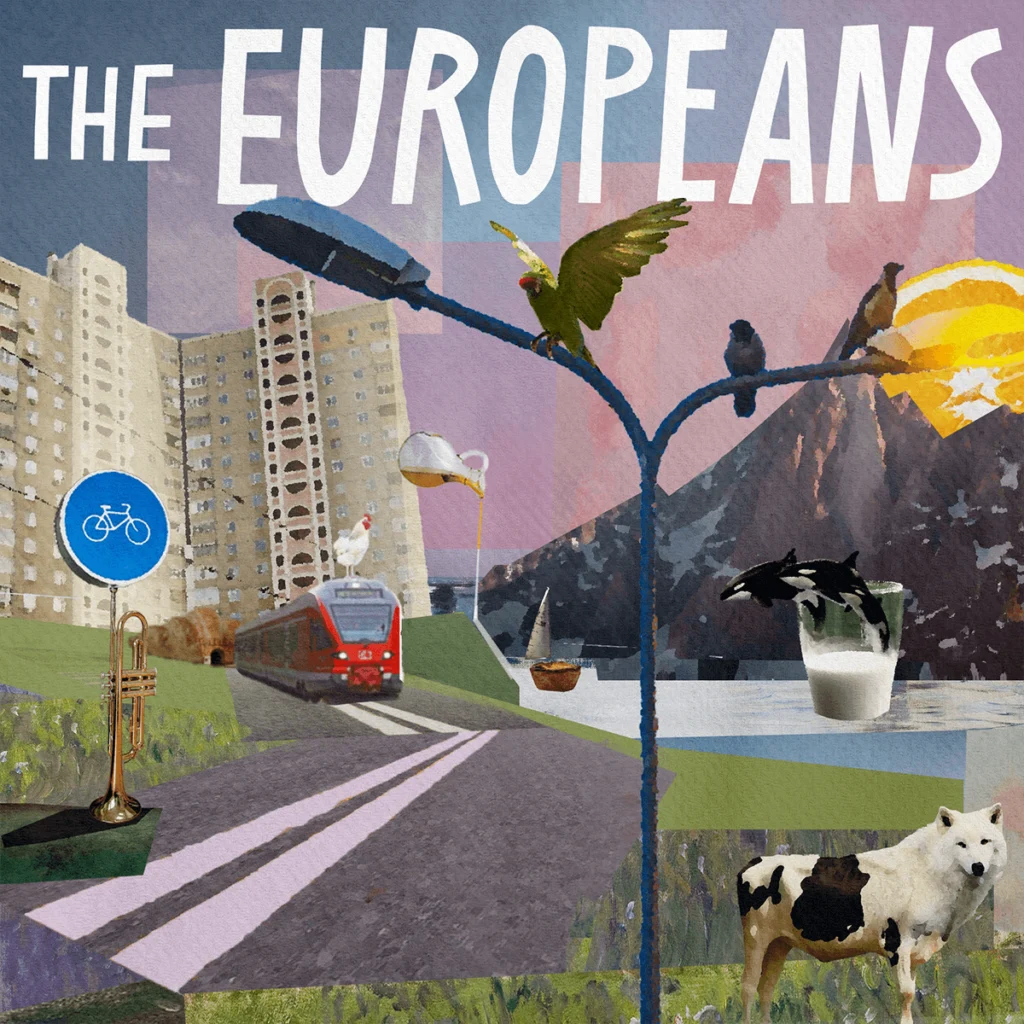
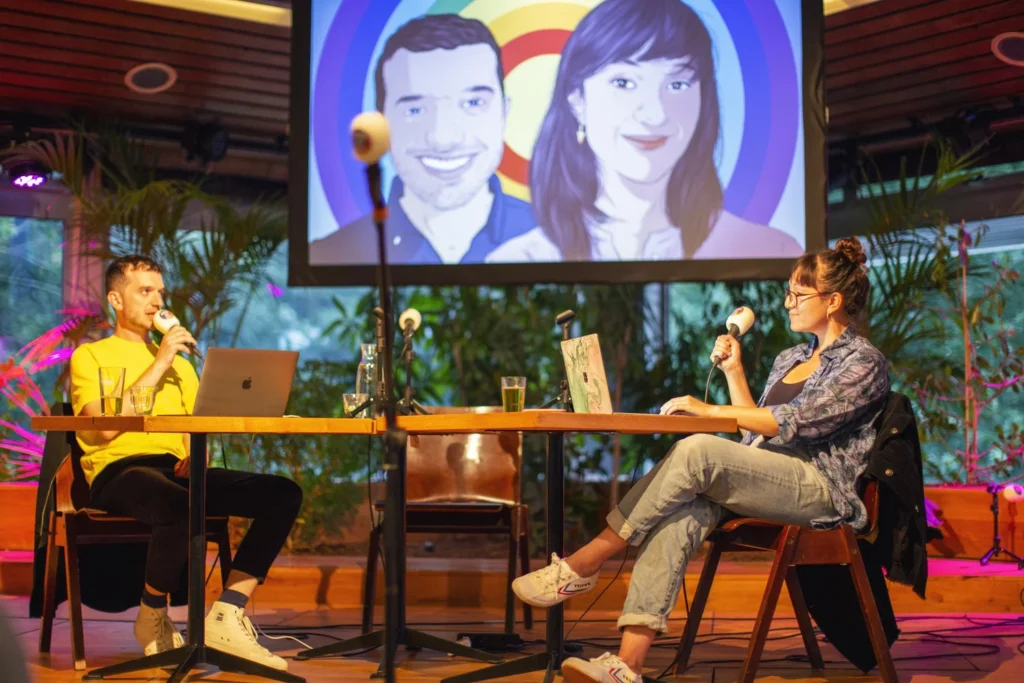
From Eurovision to a Swedish oat milk brand via a look behind the scenes at the European Union, friends Katy Lee (2006), a reporter in Paris, and Amsterdam-based opera singer Dominic Kraemer (2006) have covered them all in their award-winning podcast. Their show, The Europeans, was set up eight years ago after they decided to explore the reasons behind Brexit. Since then, they have been digging out quirky, entertaining and informative stories every week for a growing audience. We chatted with them both about how they launched their podcast and some of their favourite episodes.
How did you two meet?
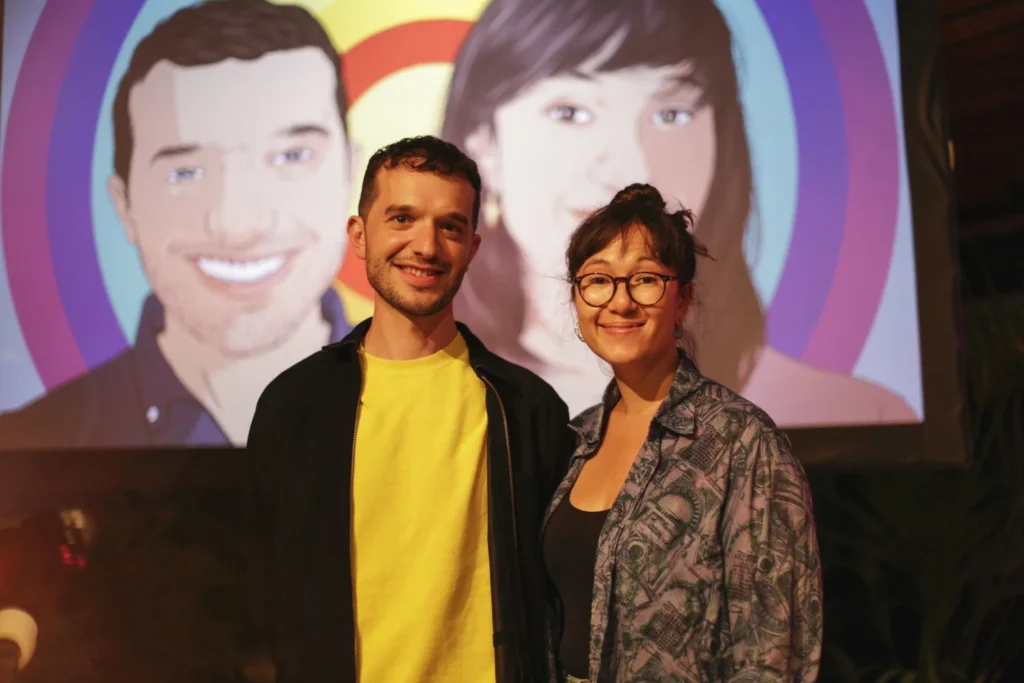
Dominic: Katy and I lived next door to each other on St John’s Road in second year, and Katy’s house was a bit noisy. I was a choral scholar who had to get my sleep so that I could sing, and sometimes I would have to ask them to please be a bit quiet. So, I was the annoying neighbour.
Katy: We know whose house was cooler. Out of those two houses on St John’s road, we had all the best parties. We were in adjacent friendship groups the whole way through our years at John’s. And then a couple of years afterwards we both ended up being in Amsterdam a lot.
Why did you decide to start a podcast together?
Dominic: Katy’s partner was living in Amsterdam at university, and I was studying here for my Masters. And Katy and I just hung out a lot and kind of reconnected, and started talking about podcasts a lot, and wondered why no one was podcasting about Europe and why Brexit had happened. We wondered whether the reason Brexit happened was because people didn’t understand Europe or think about it as something we should be interested in.
When did you launch the show?
Katy: It was 2017 and podcasting was just kicking off as a revolution. It was dawning on people that you don’t have to work for a huge media organization to produce your own radio. Anyone can do it, and the costs are fairly low. And Dominic and I were both podcast nuts.
I was working as a journalist and reporting from different countries in Europe, and Dominic’s singing took him all over Europe. So, we both felt quite comfortably European. This huge rejection of Europe in the Brexit referendum came as a big shock to us. We did a lot of soul searching about why it happened. We felt the way that Europe was represented in the media was that it was a really boring, complicated thing that you’re never going to understand. But for us Europe was much more human.
Dominic: We wanted to make a podcast that celebrates Europe as something that’s real and tangible and concrete in people’s lives. And isn’t boring. And that was the original idea behind the Europeans.
What skills did you both bring to the podcast?
Katy: I was a journalist but I had no clue how the European Union worked when we started this podcast. And so we’ve been on a mission alongside our listeners to work out how the beast works. As part of that, we made this series called Bursting the Bubble, which was taking the European Union institutions one by one, and trying to get inside them and find out in a fun way how they worked. One of them involved sort of breaking into Ursula von der Leyen’s office. It was just before she became President of the Commission. So her office was being done up, and somebody took us on a very unauthorized tour of the building. We got to see her shelves being put in. I’m overselling it.
Dominic: I felt a bit insecure at the beginning about even stepping into this project. But Katy convinced me that having someone who isn’t a journalist, someone from the cultural world, might be a nice way to make it more approachable. I’ve seen my journalistic naivety at the beginning as a bit of an advantage, but now eight years in, I’m starting to wonder whether I can really claim that I’m naive when it comes to journalism.
Katy: He’s being very British and self-deprecating. Dominic has always had really good, natural journalistic instincts and he always asks the right questions.
What have been your favourite episodes?
Dominic: Ones where we zoomed in on the smaller, more intimate stories of Europeans across Europe. We made this series of mini documentaries called This is What a Generation Sounds Like, with individual Europeans about their own lives. The one that comes to mind was about a guy called Mohamed, who was trying to achieve refugee status here. We followed him when he was in limbo, working out whether or not he was going to be able to stay here, having fled a terrible situation back home. Hearing what it’s like for someone going through that felt so powerful.
Katy: We made a mini-series about Oatly, the oat milk brand, that did really well, which is a really fun and interesting story. Oatly is a Swedish company that set themselves this quite grandiose mission of saving the world by trying to convince everyone to drink oat milk and switch from dairy to help the environment. So we made this three part mini-series about this company and its promise. It ended up being a much broader story about this thing that we might call green capitalism.
How successful is the podcast?
Dominic: I wasn’t sure about whether or not people would be interested in listening to a podcast about Europe each week. We’ve actually been really pleased to discover there is an audience for this. There are really people who feel passionately that they want to hear about what’s happening on the other side of the borders in the countries next to them. And that is one of the most cheering and uplifting things about making this show.
What is the view of the UK in Europe?
Dominic: I think right now, with the US becoming a less and less reliable partner, the UK is becoming more important again to Europe. And I feel like the EU is becoming more important to the UK. I feel like there is a bit of a turn that’s happening right now, back towards each other, because we need each other. I don’t want to make it sound like we’re these like nutty pro-European people who look uncritically at the European Union. Europe is seen as this place of full of men in suits, taking ages to make decisions and with really complicated systems. A lot of that is actually true, but a lot of those bureaucratic things are in place to protect our freedoms. We’ve also learned how a lot of stuff that got blamed on Europe pre-Brexit was actually just stuff that our national government had a say in.
Have you faced any major challenges?
Dominic: Financing a small operation like this has been a challenge from the beginning. We started off doing it unpaid from our bedrooms. But once we started bringing on extra producers in order to make sure everything was sourced properly and fact checked, then you have to start paying people properly and paying yourselves. Katy quit her other job, so it is now her primary job.
Do you have any tips about launching a podcast?
Katy: Do a bunch of practice episodes and just see if you actually like doing it before announcing it to the world. We recorded about 10 episodes to try and get into the groove. After Cambridge, I did a Master’s in London in broadcast journalism. So I was, like, semi comfortable behind the microphone. And Dominic is obviously a performer as his job, but he’d never spoken into a microphone as a job before. We wanted to have a go first and see if we were any good at it, see if we had good chemistry. Give it a go and see if it’s your thing. It can be as niche as you like. You might be interested in, like, a really specific form of fishing or something, but it doesn’t have a podcast yet. There’s a gap for you to fill there.
Dominic: I think one of the reasons why people like listening to this is because they can hear that Katy and I actually like each other and have fun together. Podcasting is quite an intimate thing, like listening to people chatting.
Were you both interested in politics before you started?
Dominic: I read Music at Cambridge, but I was really a political junkie. And part of the reason we set up this podcast is because I was really a US political junkie, like I was just listening to hours and hours of podcasts about American politics every week. This podcast was set up as a way to try and wean me off my obsession with American politics and learn a bit more about what’s happening in the countries closer to home. I do still listen to about three podcasts about US politics every week.
What did you study at St John’s?
Dominic: I was a Choral Scholar at St John’s and I sang in The Gents. I think being a choral scholar at John’s is really one of the best musical and vocal trainings you can do anywhere in Europe. So many of the top opera singers in Europe went through John’s – it’s extraordinary. I look back at it very fondly, and I miss it.
After Cambridge, I did a Master’s in vocal studies at the Royal Academy of Music in London and then I moved to the Netherlands, where I joined the Dutch National Opera Academy to finish my opera training. And now I’m on contract at Dutch National Opera.
Katy: I studied Social & Political Sciences. It was a really formative time for me professionally as well because I worked on Varsity from pretty much the beginning and was a news editor there in my second year. That allowed me to cut my teeth at being a journalist. After St John’s I went to City University London to do a Masters in broadcast journalism. I ended up going straight into an accidentally long career in print journalism from there. So straight from that masters, I got an internship at Agence France Press (AFP), which is one of the world’s big three news agencies. It’s kind of like Reuters, but the French version. A decade later, I was still working there. I moved to the Paris office, and I would commute from there to see my partner in Amsterdam and visit Dominic. It was during that time that podcasting took off and so that was why it was possible to start The Europeans as a passion project on the side of my print career.
Find The Europeans online and through your favourite podcast streamer.